Delivering Powerful Equity Compensation Insights with Worthy
Last updated: September 30, 2026
Context
Equity compensation is one of the most complex — and often underplanned — areas of a client's financial picture. Between RSU vesting events creating unexpected tax bills, ISO exercises triggering AMT exposure, and vesting schedules stretching across multiple years, advisors need a clear, centralized way to track and analyze their clients' equity positions.
Worthy's Equity Compensation feature brings all of that together in one place. It surfaces critical tax insights like the RSU withholding gap and ISO AMT exposure, tracks vesting schedules across multiple grants, and gives you a powerful AI assistant to answer real planning questions using your client's actual data — in real time.
Getting Started: Adding Your Client's Equity Grants
There are two ways to add equity compensation information into Worthy:
Option 1: Upload a Grant Document
Navigate to a client's Equity Compensation tab and click Upload. Worthy will automatically extract all relevant information from the document — grant type, shares, vesting schedule, grant price, and more — just like it does with tax returns. No manual entry required.
For guidance on which documents to request from your clients, see: What types of documents contain equity compensation information that can be uploaded to Worthy?
Option 2: Add a Grant Manually
If your client shares their equity information in a less formal way, click + Add New → Add Equity Grant and enter the details directly. You'll be prompted for:
Grant Type (RSU, RSA, ISO, or NSO)
Company Name and Ticker Symbol
Grant Date and Total Units (shares or options)
Grant Price
Vesting Schedule (this can be added later if needed)
Any additional notes
Understanding the Equity Compensation Dashboard
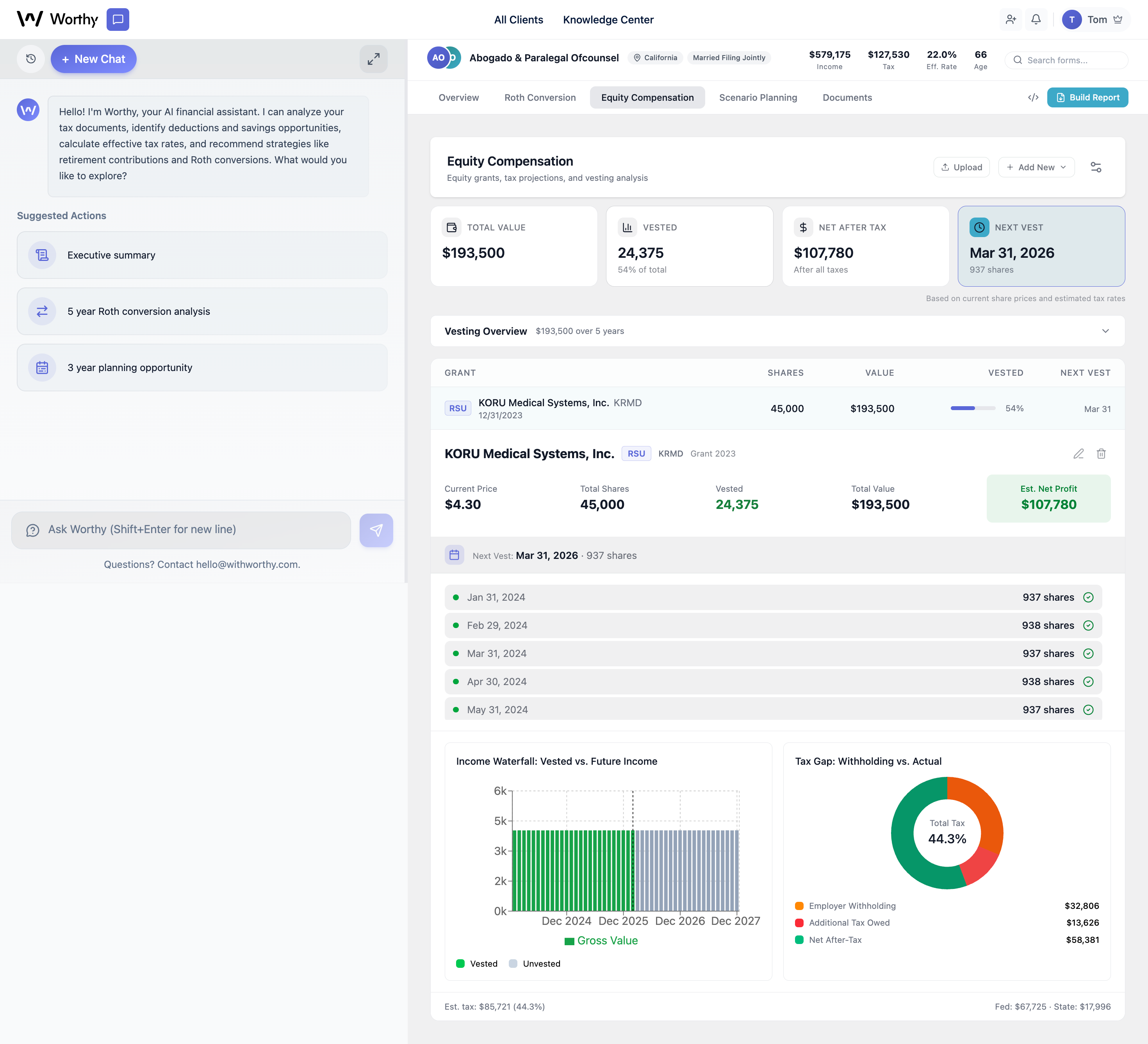
Once grants are added, the Equity Compensation tab gives you a complete picture of your client's equity positions at a glance:
Total Value — The current market value of all equity holdings
Vested — The number and percentage of shares that have already vested
Net After Tax — Estimated take-home value after all applicable taxes
Next Vest — The upcoming vest date and number of shares
The grant detail view shows individual position data — current share price, total shares, vested shares, total value, and estimated net profit. Below that, a full vesting schedule breaks down every past and upcoming vest date with the exact number of shares, so you always know what's coming and when.
An Income Waterfall chart visualizes vested versus unvested income over time, giving you a multi-year view of how equity income will flow into your client's financial picture.
RSU Withholding Gap: Catch the Tax Surprise Before It Happens
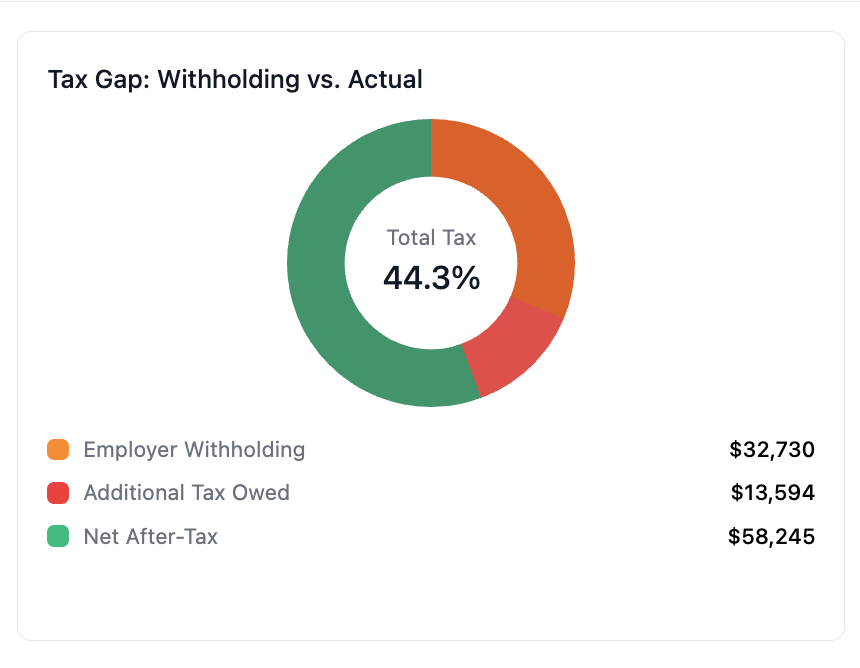
One of the most powerful insights Worthy surfaces for RSU grants is the Tax Gap — the difference between what an employer withholds from a vesting event and what your client actually owes.
Employers typically withhold at a flat supplemental rate (often 22% federally), but clients with meaningful RSU income frequently fall into higher effective tax brackets. Left unaddressed, this gap can result in a significant and unexpected tax bill at filing time.
Worthy's Tax Gap chart breaks this down clearly:
Employer Withholding — What was withheld at the time of vesting
Additional Tax Owed — The gap between withholding and actual tax liability
Net After-Tax — The client's real take-home value after all taxes
This gives you a concrete, easy-to-explain number to work with when helping clients set aside the right amount for estimated taxes — or when having a proactive conversation about adjusting withholding before next year's vesting events.
ISO Grants and AMT Exposure: Model the Impact Before It Hits
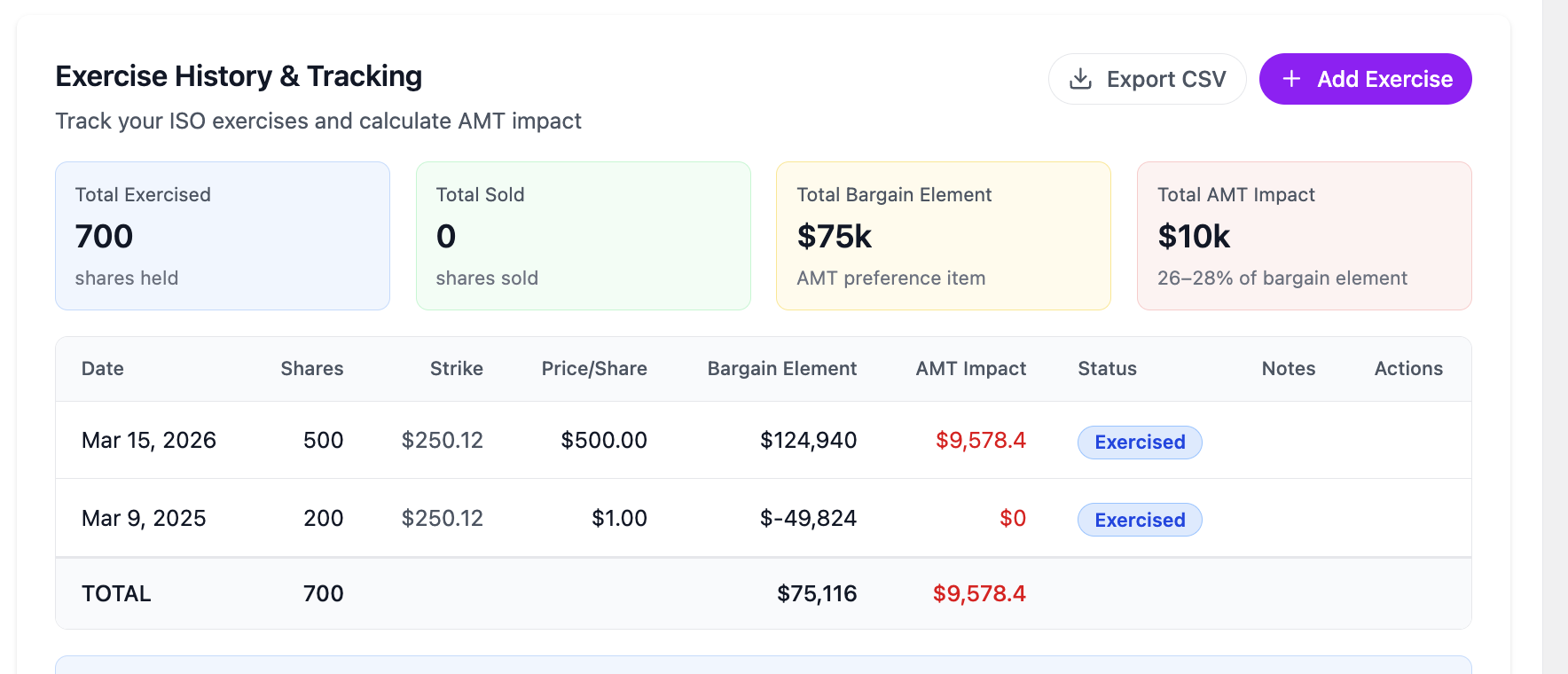
For clients holding Incentive Stock Options (ISOs), Worthy includes a dedicated Exercise History & Tracking view that calculates the AMT impact of each exercise — a critical planning consideration that is easy to overlook until it's too late.
When a client exercises an ISO, the spread between the strike price and the fair market value at exercise (the Bargain Element) becomes an AMT preference item — meaning it can trigger AMT liability even if no shares are sold. Worthy automatically calculates this for each exercise, displaying the AMT Impact at 26–28% of the bargain element.
The Exercise History & Tracking view shows:
Total Exercised — Total shares held from ISO exercises
Total Sold — Shares already sold from exercised positions
Total Bargain Element — The cumulative AMT preference item across all exercises
Total AMT Impact — Estimated AMT liability (26–28% of the total bargain element)
Each individual exercise is logged in a table showing the date, shares, strike price, price per share at exercise, bargain element, AMT impact, and status. Worthy correctly handles underwater ISOs as well — if the fair market value at exercise is below the strike price, the bargain element is negative and AMT Impact is $0.
To log an exercise and model its AMT impact, click + Add Exercise within the ISO grant view. You can also export the full exercise history as a CSV.
This gives you the visibility to have proactive conversations about ISO exercise timing — before an exercise creates an unexpected tax bill.
Ask Worthy AI About Your Client's Equity Compensation
Anything you see on the Equity Compensation tab can be explored further using the Worthy AI chat. Because Worthy has full context of your client's grants, income, vesting schedules, and tax situation, it can answer specific, data-driven planning questions — not just generic guidance.
For example, advisors have asked:
"How much ISO should my client sell to offset their high RSU income?"
"What is my client's estimated tax gap from this year's RSU vesting?"
"How will next quarter's vest affect my client's effective tax rate?"
Worthy analyzes your client's actual data — strike prices, fair market value at exercise, vesting dates, income levels, and applicable tax rates — and returns a detailed, personalized response. This is particularly valuable for complex situations, like when a client's ISOs are underwater and the right strategy involves generating a capital loss to offset ordinary income over time.
Important Notes
Worthy provides tax analysis based on current share prices and estimated tax rates. All planning decisions remain between the advisor and their client.
Worthy surfaces tax data and insights but cannot provide opinions on when to sell equity.
For public companies, tickers are automatically inferred from company names, reducing manual data entry.
Any document containing stock option information — number of shares, vesting schedule, grant type — can be uploaded to Worthy's Equity Compensation feature, regardless of the document's specific title.
Equity compensation data is fully integrated with Worthy's AI chat, meaning your questions are answered in the context of your client's complete financial picture.